🪷
🪷
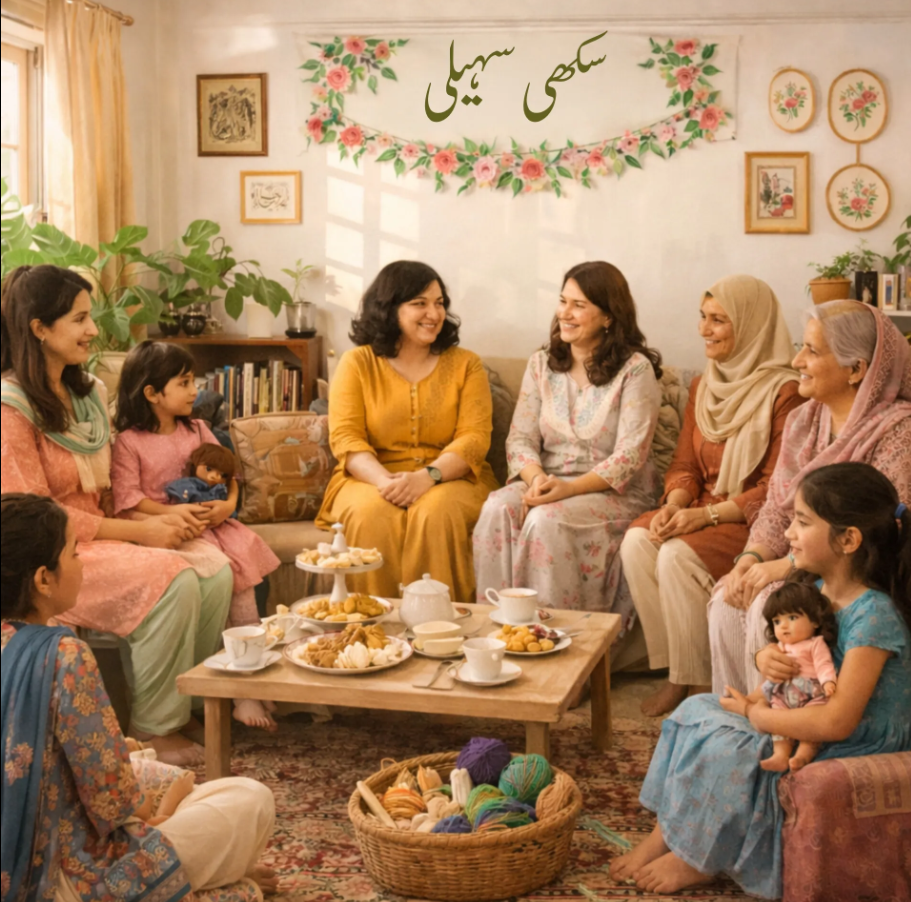
‘SUKHI SAHELI’ (Happy Woman Bestie!) is a Pakistan- and Pakistani-diaspora concept of creating self-organized circles of women, preferably in the analog/real world (especially neighborhoods) and thereafter in online spaces, to bring women together in an atmosphere of trust, collaboration, learning, and networking.
The aim is to foster local connections of trust, support, and knowledge that bring women together in an environment of not just trust, but also ethics and ability.
We envision local women meeting and organizing, networking, learning the basic of self-mastery and active citizenship using a Guided Curriculum of Basic Learning Modules, and then build a repertoire of essential and optional abilities and support systems amongst themselves, as self-selected by the group and individuals. This should eventually create not just resilient but informed, aware, and self-led groups of women citizens who work together to improve their knowledge, skills, safety and bonding together, while also enriching and gladdening their homes and communities. 🏵️
Sukhi Saheli is most essentially focused on evidence-based, reliably sourced peer-to-peer education; skill-building and practices that teach women about essentials of health, law, business, and other civic matters, and prepares them as able leaders and decisionmakers in all spaces domestic, personal, and social where women operate in. The modality is collaborative education in relaxed communal settings, organized activity, and action—centering the welfare and bonding of women and bringing up of children. The pedagogy and structure are Feminine- and matriarchy-centric, where the voices of women are validated for and by women.
Sukhi Saheli is a response to women and girls lagging behind in matters of gender-centric social coordination, civic education and decision-making, obtaining and mastering information that is women-centric, safety, autonomy, and having networks of knowledge, trade and skill-sharing that are relatively free of Masculine or male-centering work and values.
Another important aspect is to elevate women teachers, educators, developers and designers and researchers—especially those who have primary and secondary research pertaining to women and the worlds of women—and those who are frontline workers working in fields run by women or for women. In other words, we are replacing Masculine knowledge with Feminine knowledge, codes, patterns and designs for women and for women’s spheres of influence and governance and guardianship.
We are also replacing Masculine structures and priorities with Feminine priorities, though we understand that we are operating in and for the primarily (but not exclusively) Feminine domains. We are replacing Masculine dogma and doctrines with the voices, works, and opinions of women. We are also centering and honoring women’s health, instead of marginalizing it as a problem or disease, or unnecessarily adapting to male standards of how women should look and how we maintain our health.
This is not practiced as a challenge to men or masculinity, but as a useful and healthy separation of domains, and mastery of territory. This, in fact, lessens the burdens of men and brings prosperity to households and economies. We see good women and good men as partners in creating a happy, healthy society, not as competitors or adversaries.
Muslim teachings say:
“The believing men and believing women are allies of one another. They enjoin what is right and forbid what is wrong, establish prayer, give zakah, and obey Allah and His Messenger. Those – Allah will have mercy upon them. Indeed, Allah is Exalted in Might and Wise” (Quran 9:71)
We are also centering the wellness of children, with a great focus on the development arc of the girl child, and the depth of her world from childhood to adolescence and as an adult human being. Women are not treated as secondary to or in service of men and their families, but as autonomous who establish households and domains in the fields of Spirituality, Socioeconomics, and Ecology and Politics. (Note: These domains are adopted from The Salaam Matrix, which has a Four Life Zones — domains! — model of human activity.)
Because no one group of women is like another, and several values can differ significantly, we make some important matters such as health and knowledge of law central, whereas matters such as choices of dressing and household set-ups, language of communication, and meeting norms are left to each group to figure out for themselves, with our emphasis on respect for autonomy of each member while the group develops central norms that are inviolable to that group.
The core structure is imagined as this:
🪷
Women organize periodic meetings. They teach themselves about issues of importance, using a library of teachings that Sukhi Saheli the central node makes available to them, focusing on what they should generally know and what their instance-based needs are. (They can also introduce other reading materials to their circle on their discretion and at their own risk. This option is left open to ensure that Sukhi Saheli is not turned into a cult or a controlling entity.)
Women also learn skills in Four Life Zones (as defined by The Salaam Matrix)—Spiritual, Personal-Familial, Socioeconomic, Ecological-Political. All this is done from women’s perspective, using women’s models of growth and nurturing, decentering masculine paradigms and priorities.
Women undertake cooperative and collaborative projects, and also civic action as a collective when the need arises.
There is special focus on critical needs, such as puberty and safety education, setting of boundaries, learning about essential legal matters, learning negotiation and communication skills, and enterprise. Where appropriate, study circles for religious or spiritual matters may also be organized, and the central Sukhi Saheli apparatus will ensure common denominator education in that realm and leave specifics to individual circles who will be responsible for activities not sanctioned by Sukhi Saheli. There would be some parameters about what a self-organized circle may do its own but will not be associated with Sukhi Saheli’s charter.
The primary role of Sukhi Saheli is to craft the design of these meetups, craft guidelines about activities, and create a library of education resources as well as curate a selection of themes. Some educational guides would be created using evidence-based sources, and the collective wisdom of the circles will also be harnessed through user-generated input.
The emphasis will be on local and thereafter regional action.
Negative traits such as dominance, control, censure, backbiting, lobbying, grouping (to isolate someone) are strongly discouraged and feminine autonomy is celebrated, but only when it is respectful of everyone’s autonomy. More able and informed members will be encouraged to educated but not dominate and censure others but rather present their ideas and knowledge in a friendly manner. Each person will be held accountable to their own codes and will not force others–however, agreements will need to be honored, and where need be, revised but not without just cause. Violations would be accounted for and corrected and penalized after counsel has been given and points-of-view have been heard. Suggested activities will accommodate levels of flexibility and ability. Our aim is to make is convenient enough to allow participants to find an incentive in engaging positively and cooperatively within the group. Focus will be on incentive-based achievement, rather than punishment or censure for not having equal ability. Where the matters of the collective become urgent, it will be deemed a matter of honor for the participants to give their fullest to the group.
Defections, betrayal, breaking trust will be deemed serious and we will not encourage an atmosphere of washing over or ignoring neglect, sabotage, betrayal, theft and other harmful behavior. Each instance of such behavior will be duly noted and addressed, and any needed adjustment or accountability made. The idea is to differentiate between genuine inability and need for learning, vs. deliberate harm and betrayal.
The group will also arrange occasional topical counseling, and will be an ongoing learning environment.
We will also encourage women to create local resource libraries of books and tools and operate them under competent leadership.
The Sukhi Saheli Curriculum is mostly self-guided and composed of components that the Sahelis can master through mostly self-paced learning. We are using The Salaam Matrix‘s “Four Life Zones” (Spiritual, Personal-Familial, Socioeconomic, Ecological-Political) as the basic schema of life mastery. The aim of the curriculum is to make Sukhi Saheli informed, principled, empowered, and disciplined members and guardians of their own communities. We aim towards righteousness with gentleness, support, and camaraderie.
Is safhay par jald hi Urdu mein maloomat faraham ki jayen gi.
Is safhay par jald hi Urdu mein maloomaat faraham ki jayen gi.
🪷
USE THE TABS ABOVE TO NAVIGATE TO THE DESIRED SECTION.
Sukhi Saheli is an initiative conceptualized by Systems Architect and Orientation Guide, Shaykha Ramala Hubb’Allah. The idea is currently under development. A Manifesto and guidelines for organizing meetups, setting agendas, and obtaining education as well as selecting each group’s preferred activities will be published as this project develops. This is a project under the broader umbrella of The Eco-Feminine, also called Nizam-e-Jamali for use in Muslim/Subcontinental contexts.
We also want to acknowledge that India’s iconic movement The Gulabi Gang is an inspiration behind this idea, which we have adapted to our needs. We do hope that the women of Sukhi Saheli also take organized corrective action where needed. Safety and social regulation will be an important focus area of Sukhi Saheli circles.
Bookmark this page and site, and keep checking for updates! Salaam.